Living in a motorhome full-time in the UK is possible, but it sits in a grey area between parking law, planning enforcement, landowner permission, and practical tolerance. There is no single law that says “you cannot live in a vehicle,” but there is also no nationwide framework designed to support people doing it long-term.
That is why the experience often feels confusing. One authority may treat you as an ordinary parked vehicle. Another may see you as occupying land residentially. A third may only become involved if complaints are made or access is obstructed.
In practice, most problems arise not from the vehicle itself, but from where it is parked, how long it stays there, and whether someone objects.
Quick Reality Summary
- Living in a motorhome in the UK is not automatically illegal.
- Parking restrictions, planning rules, and landowner rights still apply.
- Enforcement varies significantly between councils and locations.
- Complaints from residents or businesses often trigger attention.
- Staying mobile and using permission-based overnight stops reduces risk.
- Scotland is generally more tolerant than England, but motorhomes do not have unrestricted wild camping rights.
This article is a practical overview, not legal advice. Local rules and enforcement approaches vary widely.
Why the Rules Feel So Unclear
Part of the confusion comes from the fact that several different systems overlap, but do not operate together cleanly.
DVLA Classification
Your vehicle may be registered with the DVLA as a motor caravan, van, or private light goods vehicle. That classification affects tax, insurance, and sometimes speed limits.
It does not automatically determine where you can stay overnight or whether you can live in the vehicle.
A fully legal, taxed, insured motorhome can still run into parking restrictions, local bylaws, or land-use issues depending on where it is parked.
Parking Restrictions
Public roads and car parks are controlled through local parking regulations and traffic orders.
Some councils allow overnight parking in certain areas. Others impose:
- height barriers,
- time limits,
- “no overnight sleeping” restrictions,
- seasonal controls,
- or restrictions aimed specifically at larger vehicles.
The rules vary dramatically between areas. A seafront car park that tolerates overnight motorhomes in one county may issue enforcement notices in another.
Planning and Land Use
This is where things become murkier.
If a vehicle remains on land for extended periods, particularly private land, councils may begin viewing the situation as a change of land use rather than simple parking.
The Caravan Sites and Control of Development Act 1960 was originally designed to regulate caravan sites and campsites, not individual touring motorhomes parked temporarily. But councils can still become involved if land is effectively being used for residential occupation without permission.
There is no universal “two-night rule” or “three-night rule” written into national legislation. Enforcement tends to be case-by-case and heavily influenced by context, visibility, and complaints.
Police and Enforcement Powers
Police powers are usually more relevant where there is:
- trespass,
- obstruction,
- damage,
- anti-social behaviour,
- or unauthorised encampments involving multiple vehicles.
A single motorhome parked legally and causing no issues is generally low priority. But parking on private land without permission, blocking access, or remaining somewhere after being asked to leave can escalate matters quickly.
What Usually Causes Problems
Most long-term vehicle dwellers eventually discover that enforcement is often driven less by technical legality and more by visibility and tolerance.
The situations most likely to attract attention are:
- staying in the same place repeatedly,
- visibly “setting up camp”,
- putting equipment outside the vehicle,
- waste disposal problems,
- blocking access or sight lines,
- parking in high-pressure tourist areas,
- or attracting complaints from residents or businesses.
In many places, a discreet overnight stop passes unnoticed. A vehicle that appears permanently settled often does not.
That distinction matters.
Public Roads vs Private Land
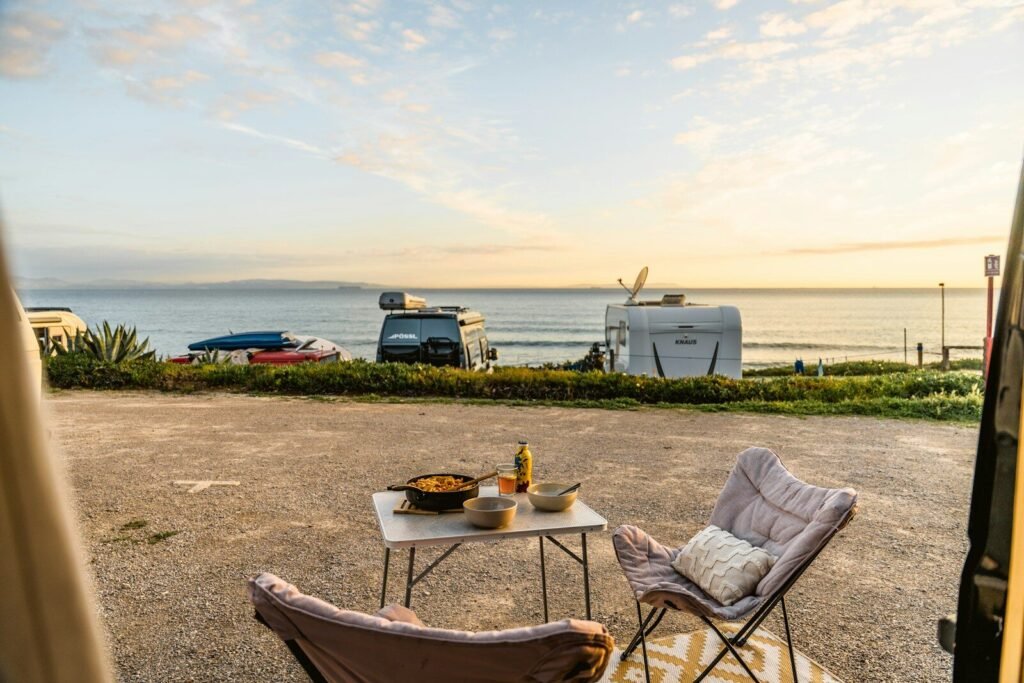
Public roads are usually simpler than private land, although local parking restrictions still apply.
Private land introduces another layer:
- landowner permission,
- planning considerations,
- and potential caravan-site licensing issues.
Permission from a landowner to park overnight does not automatically create unrestricted residential rights. But permission-based overnighting is still generally safer and more stable than relying entirely on unofficial roadside spots.
This is one reason networks like Brit Stops became popular. They provide structured overnight arrangements with participating pubs, farms, vineyards, and businesses. You are parking with permission rather than relying on ambiguity.
Scotland vs England
Scotland is often viewed as more motorhome-friendly, but the reality is more nuanced than social media suggests.
Scottish access rights under the Land Reform (Scotland) Act 2003 mainly apply to non-motorised access on land and do not create unrestricted rights for motor vehicles or motorhome camping.
However, Scotland has historically been more tolerant of informal overnight stays in some rural areas, particularly when visitors behave responsibly and avoid causing disruption.
That tolerance has limits.
In recent years, parts of the Highlands and NC500 route have seen growing pressure from littering, waste dumping, congestion, and irresponsible overnight parking. As a result, some communities and councils have introduced restrictions, signage, and local controls.
The practical reality is:
- respectful, low-impact overnighting is often tolerated,
- but motorhomes do not have an unlimited legal right to park or camp anywhere.
The Practical Reality of Full-Time Vehicle Living
Most people who successfully live in motorhomes long-term develop systems rather than relying on luck.
Typically this means:
- rotating locations,
- mixing campsites with overnight stopovers,
- using permission-based schemes,
- avoiding confrontation,
- and staying aware of local sensitivities.
The people who struggle most are usually the ones trying to remain permanently static without appropriate land or permission.
Vehicle living in the UK tends to work best when approached as mobile living rather than unofficial residential occupation in one location.
That may sound obvious, but it changes the entire experience.
Frequently Asked Questions
Can you legally live in a motorhome full-time in the UK?
There is no single UK-wide law banning full-time motorhome living. However, legality depends heavily on where the vehicle is parked, whether permission exists, and whether local restrictions or planning issues apply.
Can I park a motorhome anywhere overnight?
No. Parking restrictions, local bylaws, landowner rights, and overnight controls may still apply even if the vehicle itself is road legal.
Is wild camping in a motorhome legal in Scotland?
Not in the unrestricted way many people assume. Scotland has broader access rights than England, but those rights do not automatically extend to motor vehicles or motorhome camping everywhere.
Do I need an address if I live in a motorhome?
Usually yes. DVLA registration, insurance, banking, and electoral registration generally still require a correspondence address. Many full-time vehicle dwellers use a family address or mail-handling service.
Can councils move motorhomes on?
Yes, depending on the circumstances. Councils and police can act where parking restrictions, trespass, obstruction, land-use concerns, or other enforcement issues apply.
Final Thought
The internet often presents vehicle living in one of two ways:
- either as complete freedom with no consequences,
- or as something effectively impossible.
Neither is true.
The reality sits somewhere in the middle.
Thousands of people across the UK live part-time or full-time in motorhomes successfully. But most of them do it by understanding local tolerance, staying flexible, and avoiding the behaviours that turn a parked vehicle into an enforcement target.
Which, in many ways, is a very British system. Nothing is entirely forbidden, nothing is entirely permitted, and somewhere nearby a council officer is interpreting a policy document differently from another council officer fifty miles away.