Your leisure battery was fine last week. Now you’re sitting on a campsite at 9pm with a fridge warming up and a control panel that keeps flashing warnings at you. The battery hasn’t failed. Something is draining it. Those are different problems, and treating one as the other wastes time and money.
What follows covers the seven causes I see most often, roughly in order of likelihood. Start at the top.
1. A parasitic load you don’t know about
This is the one people miss because it’s invisible. A parasitic load is anything drawing current when you think everything is off. A faulty relay that never fully opens. A leisure battery monitor with a slightly too aggressive polling cycle. An aftermarket alarm that draws 80mA constantly instead of the usual 20mA.
The way to find it: use a clamp meter or put a multimeter in series between the battery negative terminal and the negative cable. If you’re seeing more than 30–40mA with everything genuinely off, you have a parasitic load. Then start pulling fuses one at a time until the draw drops. Whichever fuse kills the load is your starting point.
The consequence of ignoring it: a 100Ah leisure battery can be flat in two to three days without you using a single appliance. You’ll blame the battery age, buy a replacement, and have exactly the same problem six months later.
Reality check: “Everything is off” and “no current is flowing” are not the same thing. Assume they’re different until you’ve measured.
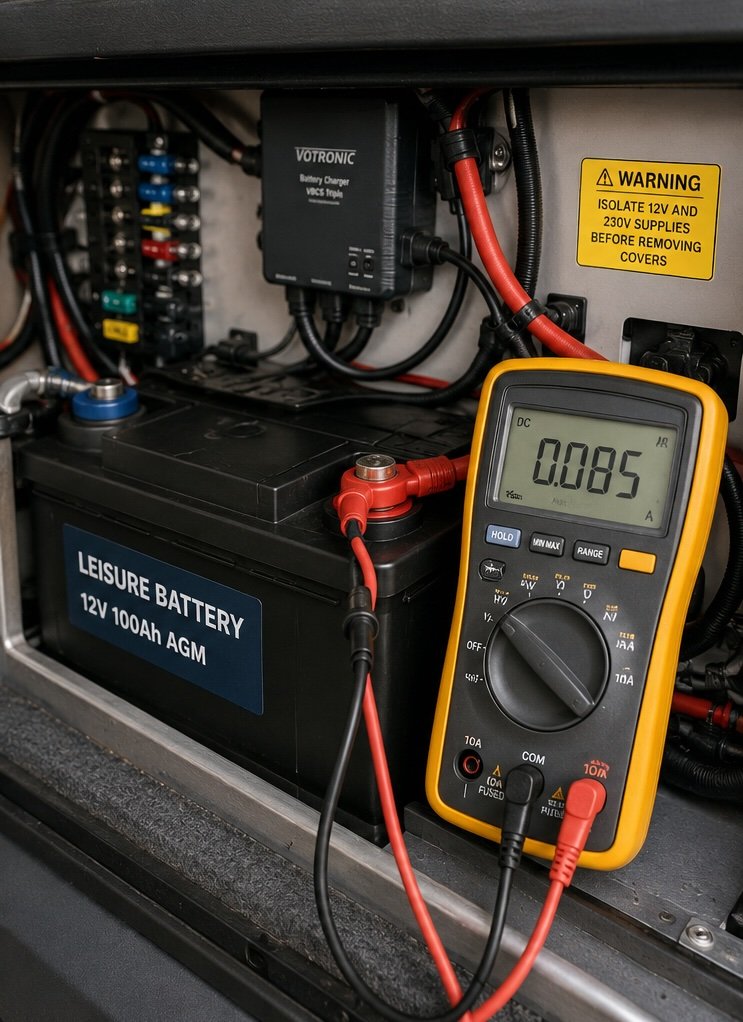
2. A battery that’s past its useful life
A leisure battery doesn’t announce its retirement. It just starts holding less charge, depleting faster, and struggling to recover after discharge. Most quality AGM batteries have a useful life of four to six years with reasonable treatment. Gel batteries similar. A wet lead-acid leisure battery used for short weekend trips and never properly charged might be done in three.
The test that matters is a load test, not an open-circuit voltage reading. A battery can show 12.6V at rest and deliver almost nothing under load. Any good auto electrician or caravan workshop can run this in ten minutes. Some do it for free.
If the battery is over five years old and you’re having drain problems, replace the battery before chasing anything else. You’ll spend less time and money overall.
3. The charger isn’t finishing the job
This is more common than people realise, particularly on older motorhomes with the original factory-fitted converter. Many basic converters charge to around 13.8V and stop. That sounds sufficient, but it’s not. A leisure battery needs to reach absorption voltage (typically 14.4–14.7V for AGM, slightly lower for gel) and hold it for long enough to genuinely fill the cells. A charger that doesn’t do this leaves the battery at 70–80% capacity, which is already starting from a deficit.
The fix: upgrade to a proper multi-stage charger. A decent CTEK or Victron charger will cost £80–£150 and pay for itself in extended battery life. If you’re running a solar panel with a cheap PWM controller, a switch to MPPT will make a noticeable difference in how fully the battery charges on partial cloud days.
Reality check: A battery that’s never fully charged will fail faster and perform worse. You’re not saving it by topping it up – you’re just delaying each discharge slightly.
4. The battery was deeply discharged and hasn’t recovered
Lead-acid batteries, including AGM and gel, do not like being discharged below 50% regularly. They actively dislike being taken below 20%. A single deep discharge event – a cold night with the heating running, a forgotten fridge left on hook-up that turned out to be mains only – can reduce a battery’s effective capacity permanently.
If the battery has been deep-discharged once and then recharged, it may appear to work but will drain noticeably faster than before. The internal structure has changed. Some capacity is gone and won’t come back with a standard charge cycle.
A desulphation mode on a quality charger can recover some capacity from a sulphated battery, but it’s not guaranteed. If the battery has been repeatedly deep-discharged over a season, the realistic option is replacement.
5. Temperature is working against you
Cold reduces usable battery capacity significantly. A leisure battery at 0°C may deliver only 50–60% of its rated capacity. That 100Ah battery becomes effectively a 55Ah battery overnight in early spring. You haven’t developed a problem – you’ve discovered a limitation that was always there.
This matters particularly if your battery is in an exposed locker with no insulation. A polystyrene box around the battery, or even some old sleeping bag material wrapped round it, makes a measurable difference in capacity retention on cold nights.
The inverse also applies: charging a very cold battery is inefficient and, in the case of lithium, potentially damaging. If you’re running a solar setup through a UK winter, expect lower yields and slower charge rates than the panel specifications suggest.
6. Appliances drawing more than you’ve accounted for
Fridge compressors cycle. Heating fans run. Water pumps activate. Each one individually is brief, but they add up. The problem is that most motorhome owners calculate daily consumption by appliance rating rather than actual use pattern. A 60W fridge compressor running 30% of the time is 14.4Wh per hour, not 60Wh.
The proper way to understand your consumption is a battery monitor with current measurement – a Victron BMV series or a Votronic equivalent. These track actual amp-hours in and out and will tell you precisely what’s being consumed. Without one, you’re guessing.
A secondary issue: compressor fridges on first startup after a warm period draw a higher current spike than their steady-state consumption suggests. If the battery is already low, this can trip the low-voltage cutoff on your control panel before the fridge has run for more than a few seconds.
Reality check: You cannot accurately manage what you haven’t measured. A battery monitor is not a luxury on a touring motorhome.
7. A failing or undersized split-charge relay
If your leisure battery charges from the vehicle alternator while driving, the circuit runs through either a voltage-sensing relay, a battery-to-battery (B2B) charger, or a diode isolator. All of these can fail or degrade.
A failing voltage-sensing relay may not activate reliably, meaning you’re driving for three hours and the leisure battery isn’t receiving meaningful charge. A diode isolator degrades over time and introduces a voltage drop that can leave your leisure battery chronically undercharged even when the relay is working.
The check: with the engine running and alternator at full output (typically after a few minutes of driving), measure the voltage at the leisure battery terminals. It should be at or close to charging voltage (14V+). If you’re seeing 13.2V or less while driving, the charging circuit isn’t working properly.
B2B chargers have largely solved this problem for newer builds. They actively control the charge and can push absorption voltage to the leisure battery regardless of alternator voltage. If you have an older system with a simple relay and diode isolator, this is worth investigating.
A note on lithium
If you’ve upgraded to lithium iron phosphate (LiFePO4), the failure modes above mostly don’t apply. Lithium doesn’t sulphate, doesn’t lose capacity from partial charging cycles, and performs much more consistently in cold. If you have a lithium bank and it’s draining fast, the investigation starts differently: look at the BMS (battery management system) fault log, check cell balance, and examine the charge source compatibility. That’s a separate conversation.
Starting point if you’re stuck
Check in this order:
- Measure the resting drain with a multimeter. If it’s over 40mA with everything off, find the parasitic load before anything else.
- Load-test the battery. Don’t guess age from memory. Test it.
- Check the charging voltage while on mains hook-up and while driving. Both should reach 14V+.
- If both check out, fit a battery monitor and run it for a week. The data will show you where the problem is.
Most leisure battery drain problems are one of those four things. Occasionally they’re all four at once, which is how a battery ends up dead on a campsite at 9pm.