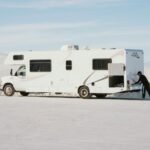
Your motorhome’s legal payload is the difference between its Maximum Technically Permissible Laden Mass (shown on the V5C logbook) and its actual Mass in Running Order – but you should aim to keep your loaded weight at 85% of maximum to account for measurement errors, accumulated gear, and mechanical safety margins.
The Layby Moment
You’re three hours into your first long trip to Scotland. Everything you packed seemed reasonable at the time: clothes for variable weather, walking boots, the toolkit you’ll probably never use, two bikes on the rack, the awning. Your partner insisted on bringing proper cooking equipment because campsite food is expensive.
Then you see the DVSA checkpoint ahead. They wave you into the weighbridge lane. The officer checks your V5C, looks at the scale reading, and hands you a prohibition notice. You’re 180kg over your Maximum Technically Permissible Laden Mass. The motorhome cannot move until you’ve removed enough weight to bring it legal. In a layby. In the rain. With a queue of traffic watching.

Everything now has to be unpacked and weighed in your head. The bikes? That’s 40kg. The awning? Another 20kg. How much does a box of books weigh? You genuinely don’t know. And the ferry you’ve paid for leaves in four hours.
What the Dealer Didn’t Tell You About Payload
When you bought your motorhome, the brochure listed a generous payload figure. What it didn’t explain is that payload isn’t a fixed specification – it’s the space left between two other weights, and one of those weights is often optimistically calculated.
Your V5C logbook lists two critical figures. The first is Maximum Technically Permissible Laden Mass, sometimes shown as “Revenue Weight” or “Gross Vehicle Weight”. This is the absolute maximum your motorhome is legally allowed to weigh when loaded, including passengers, fuel, water, gas, and everything you’ve packed.
The second figure is Mass in Running Order (MRO), sometimes called “unladen weight”. This is supposed to be the motorhome’s weight as it left the factory, plus a full tank of fuel, full gas bottle, basic tools, and a nominal 75kg for the driver. The payload is the mathematical difference between these two numbers.
Here’s what the dealer won’t volunteer: manufacturers determine MRO by weighing a single base-spec vehicle, then apply that figure to the entire model range. If you specified a larger fridge, a heavier mattress, a solar panel, an upgraded battery system, or Sargent Electrical control panels instead of basic switches, none of that additional weight appears in the official MRO. Your actual payload is smaller than the brochure claimed.
Reality Check: The 3,500kg threshold isn’t arbitrary – it’s the upper limit of what you can drive on a standard UK car licence issued after 1997. Cross that line, even by 50kg, and you’re driving without the correct entitlement. That’s six points and a potential ban, regardless of whether you knew.
How to Calculate Your Real Payload
Accurate payload calculation isn’t complicated, but it does require measuring reality instead of trusting paperwork.
Step 1: Find Your Legal Weight Limits
Open your V5C logbook to section “Revenue Weight”. This shows your MTPLM – the legal maximum. If you passed your driving test after 1 January 1997 and you don’t hold a C1 category entitlement, this number cannot exceed 3,500kg without invalidating your licence.
Note the Mass in Running Order figure listed. Write it down, but don’t trust it yet.
Step 2: Weigh Your Motorhome Empty
Drive to a public weighbridge with the motorhome as close to “ready to travel” as you can manage, but without passengers, luggage, or personal effects. Keep your fuel tank between half and three-quarters full. Leave water tanks empty. This is your baseline.
CAT Scales at truck stops will weigh your vehicle for around £10. Many agricultural suppliers and waste transfer stations also have public weighbridges. You want an axle-by-axle reading if possible, not just a total – this tells you whether weight distribution is a problem as well as total mass.
The figure you get will almost certainly be higher than the official MRO on your V5C. This is your real starting weight.
Step 3: Add Your Fixed Variables
Now add the weight of things that will always be present when you travel:
- Water: 1 litre = 1kg. A 100-litre fresh water tank adds 100kg when full. Grey waste adds more. If you wild camp and keep tanks topped up, this matters.
- Gas: A standard 6kg propane bottle weighs 12kg full (6kg gas, 6kg steel). Add this even if you run on electric hookup – the bottle stays on board.
- Additional passengers: The official MRO assumes a single 75kg driver. Add 75kg per additional regular passenger.
- Permanent fixtures you’ve added: Bike rack (20kg), solar panel (15kg), awning (20kg), spare wheel if not factory-fitted (25kg), roof box (10kg empty), additional leisure battery (30kg).
This gives you your realistic “ready to travel” weight before luggage.
Step 4: Calculate What’s Left for Luggage
Subtract your realistic ready-to-travel weight from your MTPLM. What remains is your actual payload for clothing, food, tools, sports equipment, and everything else you want to bring.
For most modern motorhomes, this figure sits between 200kg and 400kg. That sounds like a lot until you start counting: two people’s clothing and shoes for a two-week trip (40kg), food and drink (30kg), bedding (10kg), camping chairs and table (15kg), toolkit and spares (20kg), laptops and camera equipment (10kg). You’re already at 125kg before you’ve added walking boots, wine, or books.
Step 5: Apply the 85% Rule
Experienced motorhomers don’t aim for 100% of MTPLM. They aim for 85%. This buffer accounts for:
- Measurement error at weighbridges (typically ±20kg)
- Invisible accumulation – tools acquired on the road, spare parts, souvenirs, that bag of Croatian olive oil
- Mechanical safety margin – your suspension, brakes, and tyres aren’t constantly operating at their design limit
- Legal safety margin – you won’t accidentally drift into illegality after filling your water tank
If your MTPLM is 3,500kg, your target laden weight is 2,975kg. Work backwards from there.
What Happens When You Get This Wrong

The consequences of miscalculating payload aren’t hypothetical warnings. They’re specific, expensive, and immediate.
The Driver and Vehicle Standards Agency runs regular motorhome enforcement operations, particularly near ferry ports and popular tourist routes. If you’re stopped and found overweight, the fine is £300 per offence. An overloaded rear axle and an overloaded total weight count as two offences. You also receive a prohibition notice – the vehicle cannot move until weight is removed. That means unpacking in a layby, arranging collection of whatever you’re leaving behind, and rearranging your entire trip.
Insurance is simpler and worse. If you’re involved in any collision while operating over your MTPLM, your policy is void. The insurer will establish the facts, determine the vehicle was illegally overweight, and decline the claim. You become personally liable for all costs: the other party’s vehicle, their injuries, your own motorhome, and any property damage. A motorway collision can easily exceed £100,000 in liabilities.
Mechanically, sustained overloading destroys rear tyres first. Expect sidewall damage and accelerated tread wear. Replacement costs £400+ per pair for motorhome-rated tyres. Overloaded suspension compresses beyond its design range, causing habitation damage – splits in furniture joints, cracked panels, leaked tanks. The chassis flexes more than it should, fatiguing materials meant to last decades.
Braking distances extend by 20-30% when you’re operating at maximum weight. This isn’t theoretical – it’s the difference between stopping before the roundabout and not stopping at all. You feel it every time you brake hard: the momentum keeps pushing, the pedal goes soft, and the vehicle takes longer to settle.
For those choosing between motorhome options, payload capacity should be a primary selection criterion, not an afterthought. A smaller, lighter base vehicle with realistic payload often serves better than a larger vehicle that’s perpetually overweight.
Frequently Asked Questions
Can I uprate my motorhome’s weight limit to increase payload?
Sometimes. Uprating (also called “uplating”) changes your V5C to reflect a higher MTPLM, but only if the chassis manufacturer originally rated it for that weight. You cannot create payload out of nothing – the suspension, brakes, and tyres must already be capable of handling the higher weight. Specialist companies assess whether your vehicle qualifies, then apply to DVLA for the change. Cost is typically £400-£800. Be aware that crossing 3,500kg triggers C1 licence requirements and may affect insurance premiums and ferry pricing.
Do I need to weigh my motorhome every trip?
No, but you should weigh it once when fully loaded for a typical long trip. This establishes your baseline. After that, weigh again if you’ve added permanent equipment (solar panels, bike rack, second battery) or if you’re planning an unusually heavy load. Most experienced owners weigh once per year as a sanity check, usually at the start of the season.
What if my motorhome was already overweight when I bought it used?
Common problem. The previous owner may have added equipment without considering payload, or the dealer may have fitted extras without recalculating. Start by weighing it empty to establish actual MRO, then identify what can be removed. If removing factory-fitted equipment (second leisure battery, heavy furniture) still leaves you short, investigate uprating. If uprating isn’t possible and you regularly travel with passengers and gear, you may need to accept that this vehicle doesn’t suit your actual use case. Better to discover this early than after a DVSA stop.
Does motorhome payload calculation differ from caravan payload rules?
Yes. Caravans have their own weight limits and are subject to different towing regulations based on the car’s kerb weight and the driver’s licence category. Motorhomes are simpler in one sense – they’re single vehicles, so you only calculate one payload – but more complex because everything you carry (including passengers) comes out of that single budget. With caravans, passenger weight stays in the car, not the caravan payload. The principles are similar, but the specific legal limits and measurement points differ entirely.