Best Sat Navs for Motorhomes UK 2025 (Buyer’s Guide)
The first time I used a factory fitted sat nav in our Autotrail Dakota motorhome, I ended up almost wedged in a very narrow street in Honfleur in France, with an audience of locals watching in amazement. The sat nav had confidently directed me down what it assured me was the “quickest route,” completely ignoring the fact that my motorhome was 2.35 metres wide and the street wasn’t much wider.
After twenty minutes of increasingly creative manoeuvres, accompanied by a worrying silence from Christine my long suffering wife and erstwhile navigator, we finally extracted ourselves. That evening, nursing my wounded pride with a glass (or several) of local wine, I vowed never again to trust a standard sat nav with my motorhome.
Standard sat navs are brilliant for vehicles, but they’re completely oblivious to the realities of motorhome travel. They don’t know that your ‘van is 7.6 metres long, 2.35 metres wide, and 3.15 metres tall. They’ll cheerfully send you down narrow country lanes, under low bridges, or along roads with weight restrictions.
My friend Angie discovered this when her sat nav directed her through the centre of Bath in her 8-metre Hymer. “I felt like I was driving a cruise ship through a model village,” she told me later. “Every turn was an adventure, and not the good kind.”
The fundamental issue is that standard sat navs use algorithms designed for vehicles that can go virtually anywhere. They prioritise the shortest or fastest route without considering physical constraints. For motorhomes, these constraints aren’t minor inconveniences – they’re absolute barriers that can turn your holiday into a nightmare.
Features to Look For in a Motorhome Sat Nav
After my narrow incident, I spent considerable time researching what makes a sat nav suitable for motorhomes. The essential features became clear through both research and hard-earned experience.
Vehicle Profile Settings are absolutely crucial. Your sat nav needs to know your exact height, width, length, and weight. It should also know if you’re towing, carrying bikes on the back, or have anything that changes your vehicle’s dimensions.
Bridge and Tunnel Data prevents the kind of embarrassing situation I found myself in. The best units have comprehensive databases of height restrictions across the UK and Europe.
Weight Restriction Awareness is vital for larger motorhomes. Many rural roads and historic town centres have weight limits that apply to motorhomes but not cars.
Width Restriction Data helps avoid those heart-stopping moments when you’re not sure if you’ll fit through that gap between parked cars.
POI (Points of Interest) Database specifically for motorhomes should include campsites, service points, and motorhome-friendly facilities. This saves hours of research and ensures you’re not arriving at sites that can’t accommodate your vehicle.
Top 5 Motorhome Sat Navs (Reviews)
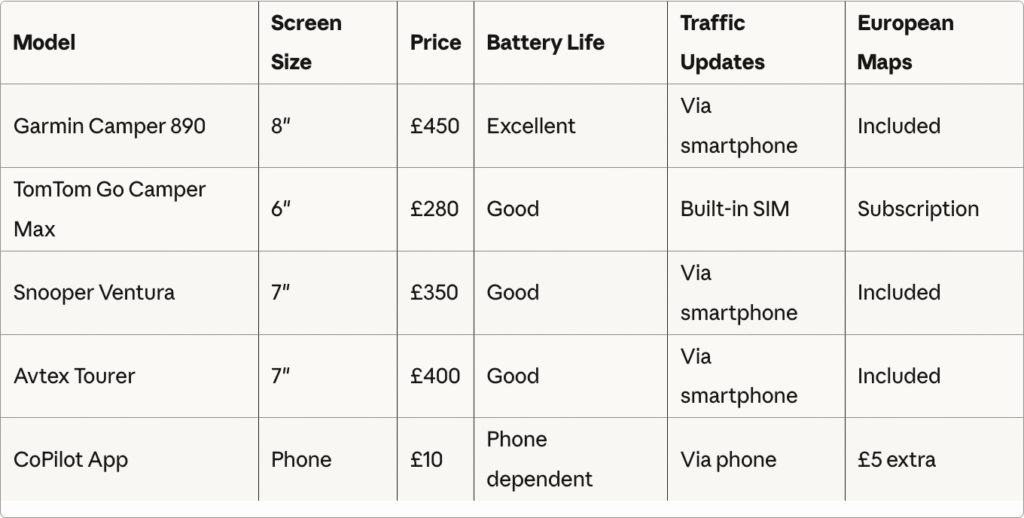
Garmin Camper 890
My friend Amanda has been using the Garmin Camper 890 for two years now, and it’s transformed her touring experience. The 8-inch screen is large enough for her to see clearly without dominating her dashboard, and the interface is intuitive enough that her technophobe partner can use it without cursing.
What sets the Garmin apart is its comprehensive database. It knows about virtually every height restriction in the UK, and Amanda tells me that she’s never been caught out by a low bridge since installing it. The routing is genuinely intelligent – it doesn’t just avoid restrictions, it finds routes that are actually suitable for large vehicles.
The integration with Garmin’s BC 40 reversing camera has been a game-changer for tight campsites. Having both navigation and reversing assistance from the same screen simplifies your dashboard considerably.
Battery life is excellent, and the magnetic mount means you can easily remove it when leaving the vehicle unattended. At around £450, it’s not cheap, but it’s proven its worth dozens of times over.
TomTom Go Camper Max
The TomTom Go Camper Max takes a different approach, focusing on ease of use and real-time updates. My cousin Graham swears by his, particularly for its traffic information and route recalculation capabilities.
Where the TomTom excels is in its traffic data. It genuinely seems to know about roadworks, accidents, and events that could affect your journey.
The 6-inch screen is smaller than the Garmin’s, but the interface is arguably cleaner. TomTom’s voice recognition is also superior – you can simply say “Navigate to Chatsworth House” and it’ll understand, which is brilliant when you’re driving.
The downside is the subscription model for traffic updates and map updates. While the initial purchase price is competitive at around £280, the ongoing costs can add up.
Snooper Ventura
The Snooper Ventura occupies an interesting middle ground. It’s designed specifically for large vehicles, and you can tell from the moment you start using it. The database of restrictions feels more comprehensive than some competitors, particularly for UK rural roads.
What impressed me about the Snooper is its local knowledge. It seems to know about those narrow sections of A-roads that aren’t officially restricted but are definitely unsuitable for large motorhomes. It’s routed users around problem areas that other sat navs would have happily sent them through.
The 7-inch screen is a good compromise between size and practicality. The mount is solid, and the build quality feels robust enough to survive the vibrations and temperature variations of motorhome life.
At around £350, it represents good value, especially if you do a lot of UK touring. The European coverage is less comprehensive than Garmin’s, so it’s perhaps not the best choice if you’re planning extensive Continental tours.
Avtex Tourer
The Avtex Tourer is the newcomer that’s been making waves in the motorhome community. What sets it apart is its integration with Avtex’s other products – if you’ve got an Avtex TV/satellite system, everything works together seamlessly.
The mapping is provided by Here (formerly Nokia Maps), which has excellent coverage and surprisingly good routing for large vehicles. The 7-inch screen is bright and clear, even in direct sunlight, which is crucial for dashboard mounting.
Where the Avtex really shines is in its motorhome-specific features. It includes a comprehensive database of Aires (European motorhome parking areas), Campervan Club sites, and even wild camping spots. For European touring, this database is genuinely useful.
The price point of around £400 puts it in direct competition with the Garmin, and while it’s newer to the market, early reports from users have been very positive.
App-Based Alternatives (CoPilot, Sygic)
Not everyone wants to invest in dedicated hardware, and smartphone apps have come a long way. I’ve tested both CoPilot and Sygic extensively, and while they’re not perfect, they’re viable alternatives for many users.
CoPilot GPS is my current system. At £10 for the premium version, it’s incredibly good value. The routing is generally reliable, and it includes vehicle profiling for motorhomes. The downside is that it’s entirely dependent on your phone, which means battery drain and potential overheating issues on hot summer days.
Sygic offers similar functionality with a slightly more modern interface. The augmented reality features are genuinely useful – it overlays navigation instructions onto your phone’s camera view, which helps with complex junctions.
Both apps work offline once you’ve downloaded the maps, which is crucial for touring in areas with poor mobile coverage. However, traffic updates require an internet connection, limiting their effectiveness compared to dedicated units with built-in SIM cards.
Comparison Table
Do You Really Need a Motorhome Sat Nav?
After my narrow street incident, this question might seem rhetorical, but it’s worth considering seriously. If you only tour on major routes between well-known destinations, a standard sat nav with careful route planning might suffice.
However, if you want the freedom to explore properly – to take that detour to the interesting-looking village, or to find the perfect lunch stop without spending an hour researching height restrictions – a proper motorhome sat nav is essential.
The peace of mind alone is worth the investment. There’s something wonderfully liberating about being able to say “navigate to nearest campsite” and knowing you’ll actually be able to access it when you arrive.
Final Thoughts
Choosing the right sat nav transformed my motorhoming experience from stressful navigation challenges to relaxed exploration. Yes, they’re more expensive than standard sat navs, but the first time your unit routes you around a problem that would have ruined your day, you’ll consider it money well spent.
For most UK tourers, I’d recommend the CoPilot app. If you want a dedicated sat nav, then my recommendation would be the Garmin Camper 890 if budget allows, or the Snooper Ventura for those wanting dedicated hardware at a lower price point. App-based solutions can work exceptionally well. Especially for occasional users or those just starting out.
Whatever you choose, make sure you input your vehicle dimensions accurately and keep the maps updated. Your future self will thank you when you’re cruising past that narrow bridge rather than being wedged underneath it.
Finally, please don’t just rely on technology. We always take a physical road atlas. It helps to look at the entire route, can highlight attractions we might miss in a pre-determined route and can highlight potential hazards and restrictions.